

What if the most important part of your remodel happens before work begins? A kitchen or bathroom renovation can seem straightforward until estimates describe different work, decisions surface, or an unexpected condition changes the plan. The right questions to ask a remodeling contractor can clarify what’s included, who handles key decisions, and how updates will be shared. It’s reasonable to want clear answers before inviting a project into your home.
This checklist will help you prepare for a productive conversation and compare estimates based on the same scope. It covers project goals, costs, communication, responsibilities, disruption, and what to discuss if the work uncovers an issue. For homeowners in Saugus, Andover, Peabody, Lynn, Lynnfield, Malden, and Revere, local requirements matter too. They can vary by project and municipality, so confirm applicable permit and inspection requirements with your local building department. King Builders Remodeling is a family-owned local contractor offering residential remodeling, including kitchen, bathroom, and basement renovations. A conversation about your priorities can help clarify the work before it begins.
Key Takeaways
- Start with your goals, priorities, and how you use the space to make the first project conversation more focused.
- Use questions to ask a remodeling contractor to clarify who you’ll communicate with and how project decisions and updates will be handled.
- Compare written estimates by scope, materials, exclusions, allowances, and procedures for changes, not just by the total.
- Describe the planned work and identify your municipality, then confirm applicable permit and inspection requirements with the local building department.
- Capture your priorities, open questions, and decisions in a brief you can use to identify what still needs clarification.
Questions to Ask a Remodeling Contractor Before Defining Your Project
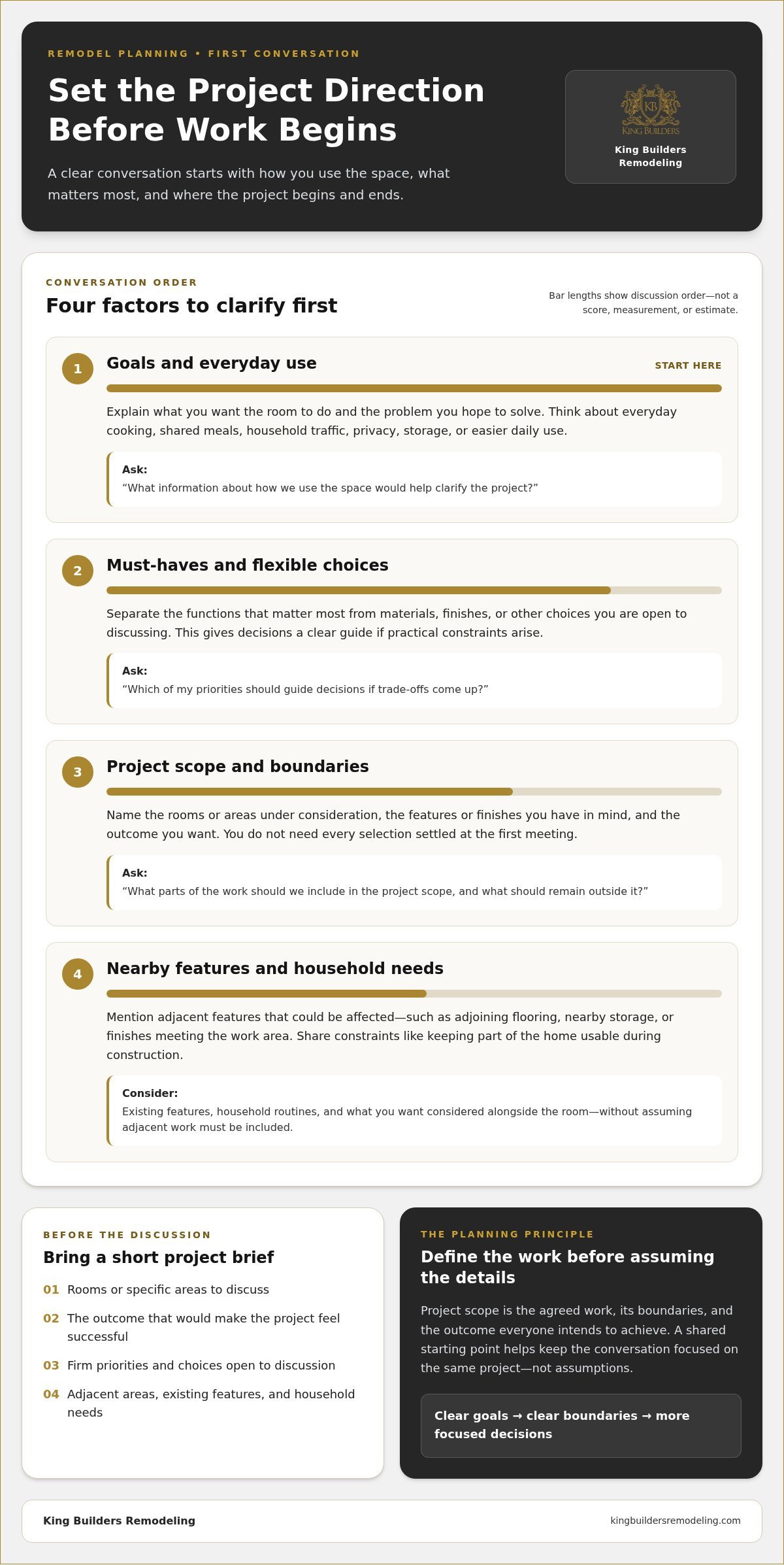
A clear first conversation makes a complex renovation easier to plan. Before choosing finishes or discussing detailed costs, explain what you want the space to do, what matters most to your household, and what constraints could shape the work. These questions to ask a remodeling contractor help turn a general idea into a useful starting point.
Project scope is the agreed work, its boundaries, and the outcome everyone intends to achieve. Defining it early helps you and the contractor discuss the same project rather than relying on assumptions.
Questions that clarify goals, priorities, and project fit
Start with how you use the space now and what you hope will change. A kitchen may need to work better for everyday cooking, shared meals, or household traffic. For a bathroom, privacy, storage, or easier everyday use may be central. Describe the problem you want to solve, not just the finish or feature you have in mind. That gives the project conversation a clearer purpose.
Separate must-haves from flexible choices. For example, list which functions matter most and which materials or finishes you’re open to discussing. This helps keep the conversation focused if practical constraints arise, such as keeping part of the home usable during the work or working within existing room boundaries.
- How can my main goals shape our initial project discussion?
- Which of my priorities should guide decisions if trade-offs come up?
- What information about how we use the space would help clarify the project?
Questions that define what is inside the project scope
Describe the areas you want to change, the features or finishes you have in mind, and the result you’re hoping for. You don’t need every selection settled at the first meeting. Ask: “What parts of the work should we include in the project scope, and what should remain outside it?”
Also mention nearby features that could be affected, such as flooring adjoining a kitchen, storage next to a bathroom, or finishes that meet the work area. For a bathroom renovation, describe the room and any adjacent areas you want considered alongside the bathroom remodeling services. This makes the project boundaries easier to discuss without assuming that adjacent work must be included.
For context on the coordinating role a renovation can involve, review this overview of a general contractor. Then relate that context to your own plans. Describing the kitchen remodeling you’re considering is more useful when you explain what you need the room to do.
Before moving into detailed decisions, write down your answers to these questions:
- Which rooms or specific areas are part of the discussion?
- What outcome would make the project feel successful?
- Are there adjacent areas, existing features, or household needs to consider?
- What choices are firm, and what are you open to discussing?
For homeowners in Saugus and nearby communities, this preparation gives a local remodeling conversation a practical starting point. Bring your priorities and questions so the discussion can focus on what matters in your home.
Questions About a Remodeling Contractor’s Team, Communication, and Process
Even a well-defined project can feel unsettled if you’re unsure who to contact, how decisions will be recorded, or what to expect at home while work is underway. Clear communication helps you stay informed and gives everyone a shared understanding of responsibilities. Add these questions to your list so you can discuss the working relationship before construction begins.
Questions about roles, responsibilities, and project decisions
Ask who will be your main project contact and who can answer questions about day-to-day work. Clarify how decisions will be communicated and how your approval will be documented before a change or selection moves forward. Agree on how to raise a concern and where decisions will be recorded, so you can refer back to the same information throughout the project.
- Who should I contact with questions during the project?
- Who will communicate decisions that affect the work?
- How will you share a decision that needs my review or approval?
- How should I raise a concern if the work differs from what I understood?
A substantial renovation, such as a kitchen project, can involve many connected decisions. The National Association of the Remodeling Industry (NARI) describes its focus on professionalism and consumer confidence. That context underscores why clear expectations and ethical communication matter when you discuss a project.
Questions about updates, site access, and household disruption
Discuss how progress updates and questions will be handled, including what to do if something needs attention between planned updates. Don’t assume every project follows the same schedule or communication routine. Talk through the approach for your specific home and work, then plan around access needs and daily routines.
- How will I receive progress updates, and how should I send questions?
- How will we coordinate access to the work areas?
- Where should workers park, and are there access constraints to discuss?
- What should I plan for if pets, children, or household routines affect the work area?
- What work-hour and scheduling details should we establish for this project?
Raise practical details early, even if they seem minor. A narrow driveway, a pet that needs to stay separated from the work area, or a household member who uses a particular entrance can affect site planning. Explain what matters in your home, then make sure the expectations you agree on are recorded somewhere both sides can refer to.
For a remodeling project in Saugus or a nearby community, you can share your project details with King Builders Remodeling to begin a conversation about your goals and household needs.
Questions to Ask About Remodeling Estimates, Contracts, and Changes
A lower total doesn’t necessarily mean an estimate covers the same work as another. Estimates are easier to compare when they describe the same scope. Ask for written details about what the price includes, what it leaves out, and how changes will be discussed. These questions can help you understand the terms before deciding how to proceed.
Questions that make estimates easier to understand
Ask which labor, materials, and project areas the estimate covers. Look for details that could affect the comparison, including finish selections, items listed as allowances, exclusions, and assumptions about existing conditions. If a phrase is unclear, ask what it means for the work in your home. Focus on the written description rather than comparing totals without context.
- Which work areas and labor are included in this estimate?
- What materials or finishes does it describe, and what selections remain open?
- Are there allowances or assumptions I should understand?
- What work or conditions are excluded?
Use a side-by-side comparison to spot gaps. Copy this framework into your notes and fill it in from each written proposal:
| Compare | What to clarify |
|---|---|
| Scope | Which work areas and tasks are included? |
| Materials | What materials or finish details are identified? |
| Exclusions | What work is outside the estimate? |
| Allowances | What choices or assumptions do they cover? |
| Changes | How are proposed changes documented and approved? |
Comparing each category helps you see whether differences reflect the work, the materials, or a boundary that needs clarification. If one proposal says “finish work” while another names specific areas, ask what each description means before treating the estimates as equivalent. Note any missing information so you can ask the same follow-up questions about each proposal.
Questions about changes and unforeseen conditions
Remodeling can reveal conditions that weren’t visible before work began. Ask how the contractor will explain the condition, describe any proposed change, and document your decision. This gives you a chance to understand the options and implications before responding, rather than relying on an informal conversation after the work has changed.
- How will a proposed change be described and recorded?
- Will I have a chance to review and approve it before the work changes?
- How will a newly discovered condition affect the written scope or project terms?
- Where are payment terms and any related changes explained in the contract?
Read the written agreement alongside the estimate, and note any differences or unanswered questions. To discuss a project tailored to your home, you can share your remodeling project details with King Builders Remodeling.
Massachusetts Remodeling Questions About Permits, Inspections, and Local Conditions
Permit and inspection requirements aren’t identical for every renovation. In Massachusetts, what applies depends on the proposed work and the municipality where the property is located. Describe the work, identify the town, then confirm applicable requirements with that town’s building department. This keeps the conversation grounded in your project rather than assumptions about a similar renovation elsewhere.
Questions about project-specific permits and inspections
Describe the planned work in plain terms, including which areas will change and whether the project involves alterations to existing features. Ask which details may affect applicable permits or inspections, and what questions remain for the local building department. These are useful questions to ask a remodeling contractor before work begins, but the municipality is the appropriate place to confirm its requirements.
- Which details of my proposed work could affect applicable requirements?
- What should I describe to the local building department when confirming them?
- Are there project-specific inspection questions I should clarify with the town?
Keep a note of the municipality, the work being discussed, and the guidance you receive. If the project changes, revisit whether that guidance still applies. Don’t rely on a neighbor’s past renovation or a general online answer as confirmation for your property. Requirements can vary by project and municipality, so direct local confirmation matters.
Questions about local site conditions and project planning
Local context also includes the conditions at your particular home. Before planning access, discuss how workers and materials may reach the work area, where the household needs clear passage, and whether nearby rooms or features could be affected. For a kitchen renovation, explain which entrances and adjoining spaces your household uses regularly. For a bathroom project, mention any nearby area that needs to remain accessible.
Ask how existing conditions at the property will be considered as the work is planned, and how a newly noticed issue will be brought to your attention. This doesn’t predict a problem or its outcome. It establishes how to communicate if something needs further review. Parking, shared access, pets, and daily routines are also worth raising early because they can shape practical site coordination.
Saugus, Andover, Peabody, Lynn, Lynnfield, Malden, and Revere each have their own local context. Naming the project location helps focus the conversation, while the local building department can clarify requirements for that municipality. Bring a concise description of the work and your property questions to that conversation.
Using Contractor Questions to Choose Next Steps
A project conversation can give you a useful next step even if some choices remain open. Put together a one-page brief with your goals, priorities, decisions, and unanswered questions. Keep it nearby as you review project information, and update it when something changes. That record helps distinguish decisions you’ve made from ones that still need discussion.
A simple checklist for comparing project conversations
Use your notes to check whether you understand the project boundaries, responsibilities, communication approach, written terms, and any local requirements to confirm. Don’t score conversations with an arbitrary rating. Instead, write down what’s clear, what remains uncertain, and what next step would resolve each open question. For estimates, use the same scope and comparison categories so you can identify gaps instead of relying on the total alone.
Discuss your renovation with a local remodeling team
King Builders Remodeling is a family-owned remodeling and construction company serving Saugus and nearby communities, including Andover, Peabody, Lynn, Lynnfield, Malden, and Revere. If you’re ready to talk through a renovation, bring your brief and share what you hope to change. You can start the conversation without having every selection or decision settled.
Take the First Step Toward a Clearer Renovation Plan
You don’t need every detail settled before beginning a remodeling conversation. Start with the change that would make the greatest difference in your home, then use your questions to ask a remodeling contractor to explore what that goal could involve. As decisions take shape, keep your project notes current so new ideas and open questions have a clear place.
A thoughtful first discussion can help turn an early idea into a practical path forward. Share what you hope to improve, what matters most to your household, and where you’d like guidance. King Builders Remodeling handles residential and commercial remodeling and construction in Massachusetts.
Your renovation can begin with one clear goal and a straightforward conversation. Take the next step when you’re ready.
Frequently Asked Questions
Is it better to get a written estimate before remodeling work begins?
Yes. A written estimate gives you a document to review and discuss before deciding how to proceed. Check that it identifies the work areas, materials or selections, and assumptions that could affect your understanding. If you’re reviewing more than one estimate, compare what each describes rather than focusing on totals alone. Note unclear wording and request clarification in writing so you can refer back to the answers.
Can I live in my home during a remodeling project?
Sometimes, but whether it’s practical depends on the rooms affected, access to essential spaces, the work sequence, and your household’s needs. A kitchen renovation may make meal routines harder to maintain, while bathroom work can affect access to a frequently used room. Discuss which spaces may be unavailable and what arrangements your household can manage. Consider children, pets, work-from-home needs, and anyone who relies on a particular entrance or room.
How much detail should a remodeling project scope include?
Include enough detail that someone reading it can understand the planned work without guessing what a broad phrase means. Identify the areas involved, the intended result, and any relevant materials or selections already discussed. Note open choices separately so they aren’t mistaken for final decisions. For instance, if a scope mentions flooring, clarify which rooms that refers to. The level of detail depends on the project, but unclear wording is a good reason to pause and ask.
What happens if a contractor discovers an unexpected issue during remodeling?
The next steps depend on what’s uncovered and the terms of your project agreement. Ask for an explanation of the condition and what options or decisions may follow before agreeing to a change. For example, if an existing surface or structure differs from what was visible, request a clear description of how that affects the proposed work. Keep a record of the discussion and any agreed updates. Confirm applicable local requirements with the building department when appropriate.
When should I contact a remodeling contractor about a project?
Start once you can explain which space you want to change and what you’d like it to do better. You don’t need to choose every finish first. A short list of priorities, questions to ask a remodeling contractor, and photos or notes about the current space can make an initial conversation more useful. If you’re considering a kitchen or bathroom renovation, note which household routines depend on that room so those needs can shape early planning.
Do remodeling permits and inspections work the same way in every Massachusetts town?
No. Applicable requirements depend on the proposed work and the municipality, so don’t assume an answer for one town applies elsewhere. Homeowners in Saugus, Andover, Peabody, Lynn, Lynnfield, Malden, and Revere should describe the specific project and confirm relevant requirements with the building department serving the property. Bring a clear description of the planned changes, and follow up with the department if the work or project details change.
Can I change my remodeling plans after work has started?
You can raise a requested change, but its effect depends on the project and agreement. Bring it up as soon as you’re considering it, before assuming it can be incorporated without affecting other details. Ask for the proposed revision and its implications to be explained and documented, then review the updated information before approving the change. For instance, changing a finish may involve different selections than changing the area or type of work.