

The most ambitious renovation isn’t always the one that makes the most sense for your home or budget. A home renovation ROI calculator MA can help you compare options, but its result is an estimate, not a promise of what you’ll recoup when you sell.
It’s reasonable to want a clearer picture before committing to a kitchen, bathroom, or basement project. Online figures can offer a starting point, yet they may not reflect your home’s condition, the exact project scope, or the market in your North Shore or Greater Boston community. Massachusetts homes, including older homes, can also bring their own planning considerations, so a national average may not tell the whole story.
This article shows you how to build a transparent estimate and compare renovation priorities using consistent assumptions. You’ll learn which local factors can affect your calculation, why resale value isn’t guaranteed, and how to weigh everyday comfort alongside potential financial return. Requirements for permits, inspections, zoning, or building codes can vary by project and municipality, so confirm what applies to your home with your local building department. With a practical plan, you can make a more confident decision based on your goals, not a headline percentage.
Key Takeaways
- Use a home renovation ROI calculator MA as a planning tool, not a promise of resale value.
- Compare potential value gain with project cost, and label each figure as an estimate, sourced figure, or confirmed project figure.
- Assess kitchen, bathroom, basement, and addition projects using the same criteria, including intended benefit and uncertainty.
- Make your estimate more locally relevant with comparable homes in your municipality and similar property category.
- Use your priorities to define project scope, then refine the cost input with a contractor’s estimate.
What a Home Renovation ROI Calculator Can Tell You in Massachusetts
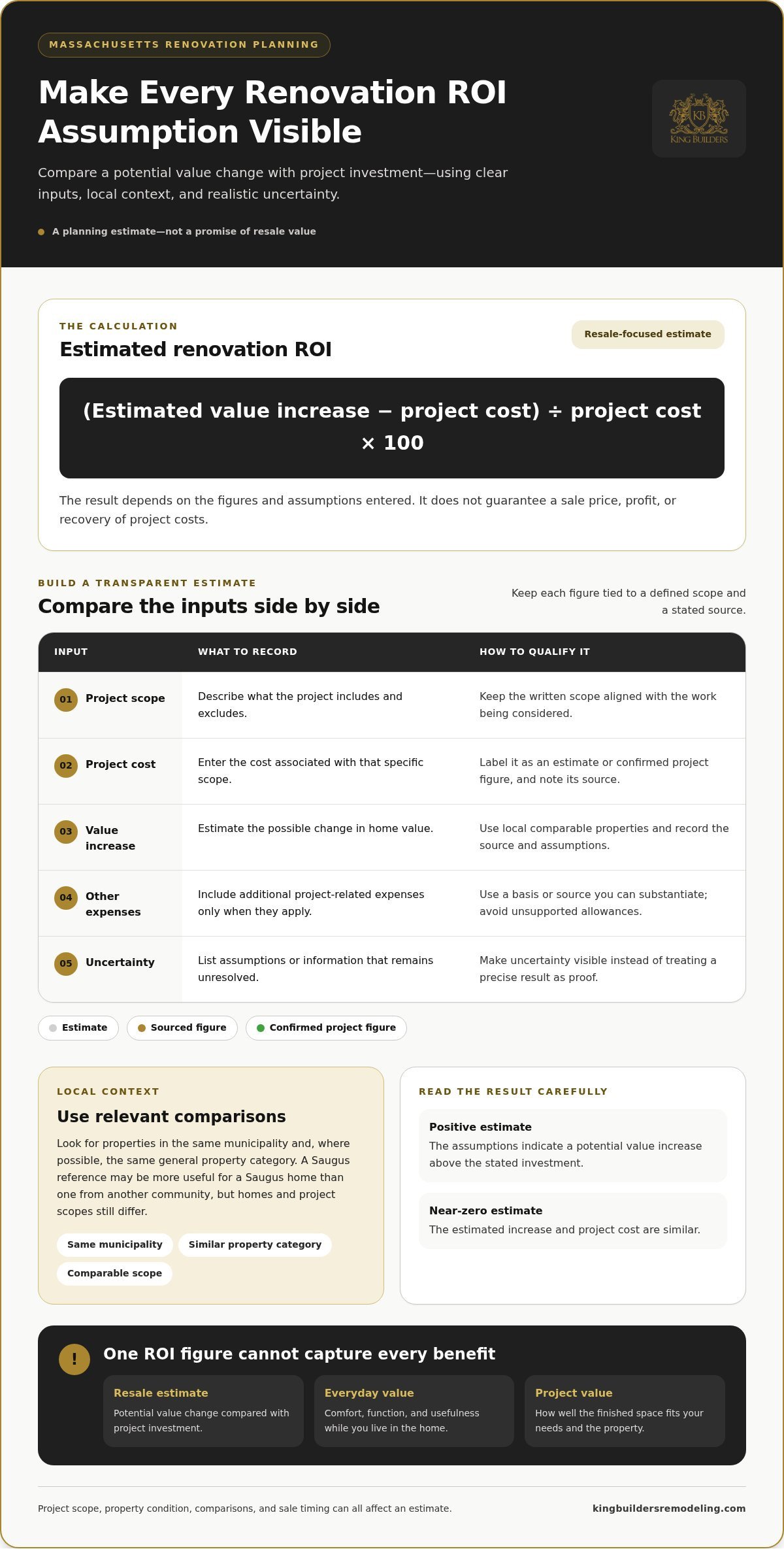
A home renovation ROI calculator MA can help you organize a resale-focused estimate before choosing a project. It compares a potential change in your home’s value with the investment required to complete the work. The result is a planning aid, not a prediction of what a buyer will pay or a promise that you’ll recover your costs.
Estimated renovation ROI is a comparison based on stated assumptions, not a guaranteed sale price, profit, or resale outcome. A calculator can only use the information entered, so its estimate may shift with the property’s current condition, the project scope and execution, the quality of the comparison data, and the timing of a future sale.
Renovations can also serve goals a resale calculation doesn’t capture. A remodeled kitchen may make daily routines easier; a finished basement may provide more usable space for your household. Those practical and personal benefits can matter even if they don’t translate directly into a higher sale price. A general overview of renovation, the process of improving broken, damaged, or outdated structures, can help put the work in context, but your home’s value still depends on its own circumstances.
What does renovation ROI measure?
A resale-oriented estimate asks whether the expected value change could justify the total project investment. It’s different from a measure of comfort, appearance, or function. A positive estimate means only that the assumptions suggest a potential value gain greater than the stated investment. It doesn’t establish your eventual sale price, account for every selling expense, or guarantee a financial profit.
Keep the goals distinct as you assess a project:
- Resale estimate: potential value change compared with project investment.
- Everyday value: comfort, function, and usefulness while you live in the home.
- Project value: the fit between the finished space, your needs, and the property.
One project may serve more than one goal, but a single ROI figure can’t represent them all. Decide which benefit matters most before interpreting the number.
Why Massachusetts location matters to the estimate
Local context helps keep a resale estimate grounded. Compare your home with properties in the same municipality and, where possible, the same general property category. A similar home in Saugus may offer a more useful reference for a Saugus property than one in another community, but no two homes are identical. Differences in condition, layout, and renovation scope can still affect how relevant a comparison is.
North Shore and Greater Boston communities don’t form one interchangeable market. A Peabody home and a Revere home may appeal to different buyers and have different nearby comparables. Treat each example as a local reference point, not a substitute for examining the market around your own property. If comparisons are limited or don’t closely match, note that uncertainty rather than treating a precise calculator result as proof.
How to Calculate Home Renovation ROI: Inputs and Formula
Once you’ve chosen what you want to measure, keep the calculation simple and make every assumption visible. For a resale-oriented estimate, use:
Estimated ROI = (estimated value increase − project cost) ÷ project cost × 100
A home renovation ROI calculator MA is only as reliable as its inputs. A result can look precise even when the figures are rough, so record whether each value is an estimate, a sourced figure, or a confirmed project figure. That distinction shows you what needs refining before you compare options or make a decision.
Which figures should go into the calculator?
Start with a written scope that describes what the project includes and excludes. Keep that scope separate from the contractor’s estimate, which should correspond to the work being considered. If the scope changes, update the estimate and calculation together. That way, you won’t compare a broad wish list with a figure for a narrower project.
Use local comparable properties to inform the estimated value change, rather than relying on broad national averages. For a practical worksheet, copy these prompts and fill in only what you can support:
- Project scope: __________ (defined by: __________)
- Project cost: __________ (estimate or confirmed figure; source/date: __________)
- Estimated value increase: __________ (comparable-property source and assumptions: __________)
- Other project-related expenses included: __________ (basis or source: __________)
- Unresolved assumptions: __________
Include additional expenses only when they apply to your project and you can substantiate them. Avoid adding a general allowance just to make the worksheet seem more complete. For a broader view of remodeling activity, Harvard’s Joint Center for Housing Studies tracks industry conditions through its Leading Indicator of Remodeling Activity. This market context can inform your thinking, but it doesn’t establish the likely value change for an individual home.
How to read the result without overclaiming
A positive result means your assumptions indicate a potential value increase above the project cost. A result near zero suggests the estimated increase and cost are similar; a negative result means the estimated increase falls below the cost. These are scenario outcomes, not predictions or guarantees. The calculation also doesn’t assign a resale price to daily comfort, improved function, or the personal value of enjoying the finished space.
Test the assumptions. If you narrow the scope, revise the cost input to match. If your comparable properties are less similar than you first thought, lower your confidence in the value estimate. The result should change when its inputs change. That’s useful information, not a flaw in the worksheet.
For a project-specific cost input, a contractor estimate can help connect your planned scope to the work involved. King Builders Remodeling helps North Shore and Greater Boston homeowners develop practical renovation plans. You can request a project quote to refine that part of your worksheet.
Compare Kitchen, Bathroom, Basement, and Addition Projects Fairly
A useful comparison puts each renovation through the same decision process. Don’t rank a kitchen refresh against a full addition using broad project labels alone. Define the scope, record a cost input that matches it, and consider how the finished space would serve your household and fit the home. The project category alone cannot determine a home’s individual ROI; details and local evidence matter.
Use this worksheet to organize questions for each option. Fill in costs and value assumptions from your own documented sources rather than relying on generic figures.
| Project type | Intended benefit | Cost input | Local evidence | Uncertainty to consider |
|---|---|---|---|---|
| Kitchen | Improve workflow, storage, or buyer appeal | Estimate for the defined refresh or remodel scope | Comparable homes with similar kitchens and property type | Differences in layout, finish level, and existing condition |
| Bathroom | Address function, comfort, or outdated features | Estimate tied to the specific bathroom work | Nearby properties with a similar number and type of bathrooms | Whether the work addresses a personal need, resale appeal, or both |
| Basement | Create more usable household space | Estimate for the planned finished area and scope | Comparable homes with relevant usable-space features | How the existing basement condition affects the scope |
| Addition | Expand living space or accommodate changing needs | Estimate for the defined addition project | Similar properties and additions in the same local market | How the added space fits the home and surrounding properties |
What to compare across renovation options
Keep the comparison consistent: use the same cost basis, property category, and approach to estimating potential value change. Then ask whether each improvement fits the home and expectations reflected in relevant nearby properties. Your priorities matter too. A growing household may value additional space, while a homeowner planning to move sooner may weigh resale appeal more heavily. Neither goal should be hidden inside a single percentage.
For a kitchen project, defining what changes and what stays can make the estimate more meaningful. This kitchen remodeling guide offers scope-planning context to help clarify the work before comparing it with other options.
When a project’s value is more than resale
A renovation may improve comfort, usability, or the condition of a space even if those benefits don’t appear in a sale-price estimate. Record them separately as household priorities, not as unsupported dollar amounts. For example, a bathroom update might make daily routines easier, while a basement project could provide space your family needs now. That context helps you compare options honestly without asking the ROI calculation to measure what it can’t.
With a home renovation ROI calculator MA, compare the same kinds of evidence and assumptions across projects, then weigh the estimate alongside your intended use and time in the home. This gives you a clearer basis for choosing a scope that fits both your property and your plans.
Make Your Massachusetts ROI Estimate More Relevant to Your Home
A calculator becomes more useful when its assumptions reflect the home and community you’re evaluating. Start with comparable properties in the same municipality and a similar property category, then consider whether their condition and features make them meaningful references. A broad average may offer background, but it can’t account for the details that shape a specific project or property.
Choose local evidence carefully
Look for recent, relevant comparisons where reliable information is available. A nearby property can still be a poor match if it differs substantially in size, layout, condition, or the features your project would change. An outcome from a neighboring town may provide context, but it isn’t a precise forecast for your home. Saugus, Peabody, and Revere each have their own mix of properties and local market conditions.
Keep a brief record of each source so you can revisit your assumptions rather than treating a number as settled. Note:
- Where the information came from, such as a public property record or another identifiable market source.
- When it was published or collected, since market conditions and available evidence can change.
- How closely it matches your home’s property type, condition, and planned scope.
If evidence is old, incomplete, or based on homes that differ from yours, mark the estimate as less certain. Avoid blending unlike comparisons into a single figure that appears more dependable than the underlying information.
Account for project and municipal uncertainty
Your estimate also depends on what the work uncovers and what the final scope includes. Existing property conditions can affect the work needed; a change in materials, layout, or project boundaries can change the investment. Keep the original scope and any revisions clear in your records. If you’re comparing scenarios, update the cost and potential value assumptions together so each version describes the same project.
For homeowners in North Shore and Greater Boston communities, local context includes more than nearby property comparisons. Requirements related to permits, inspections, zoning, and building codes can vary by project and municipality. Don’t assume a rule that applied to another property or town automatically applies to yours. When project details raise these questions, confirm applicable requirements with your local building department before relying on them in your planning.
King Builders Remodeling serves homeowners in Saugus, Andover, Peabody, Lynn, Lynnfield, Malden, and Revere, communities with different property contexts. A well-labeled home renovation ROI calculator MA should make uncertainty visible, not disguise it. That gives you a more honest basis for deciding whether a project fits your goals.
Turn Your Renovation ROI Estimate into a Practical Project Plan
A calculator can help organize your thinking, but the next step is to turn its findings into a scope you can describe clearly. Don’t let one percentage make the decision for you. Consider what needs attention, what would improve daily use, how long you expect to stay in the home, and whether resale is a near-term priority. A practical plan should reflect the whole picture.
Use the estimate to set project priorities
Start by ranking the work according to function, property condition, household needs, and resale considerations. Separate essential scope from optional upgrades so you can compare a focused version with a broader one. For example, list the changes needed to address a bathroom’s current limitations separately from finish choices that are desirable but not central to how the room works.
That separation makes it easier to discuss choices without losing sight of the project’s purpose. If the estimate looks less favorable for the full scope, revisit the optional items and consider whether a narrower plan still meets your goals. Avoid removing work that addresses a real condition just to improve a projected percentage. A sound renovation plan serves the home and the people living in it, not just the worksheet.
Before settling on a bathroom scope, clarify which improvements matter most to your household and how the finished room should function. Those priorities can guide a focused discussion about bathroom remodeling.
Discuss a project plan with a local contractor
A project-specific conversation can turn a general idea into a clearer description of the work. A contractor estimate based on that scope can refine the cost input in your worksheet, while questions about what is included can help you compare scenarios consistently. If the planned work raises permit, inspection, zoning, or code questions, requirements can vary by project and municipality, so confirm them with the local building department.
King Builders Remodeling is a family-owned Massachusetts contractor with more than 10 years of experience. The goal of planning isn’t to promise a resale outcome. It’s to understand the work, make informed choices, and shape a renovation around your priorities. Bring your notes, the scope you’re considering, and the assumptions behind your estimate to the conversation. That gives everyone a clearer place to begin.
Whether you’re planning a kitchen, bathroom, basement, or addition, King Builders Remodeling can discuss your goals and prepare a project quote. Use the estimate as a starting point, then refine the plan around your home and intended scope.
Make Your Next Renovation Decision with Confidence
Your estimate doesn’t have to settle every question before you take a next step. Use it to identify what you still need to clarify: the project scope, the cost assumptions, or the local evidence behind a possible value change. A home renovation ROI calculator MA is most useful when it helps you ask better questions and make a plan that fits your home, budget, and priorities.
Bring your notes into a project conversation. Describe what you want the finished space to do, what matters most to your household, and which parts of the estimate feel uncertain. A clear discussion can help turn those priorities into a defined scope and a more grounded cost estimate, without treating resale value as guaranteed.
King Builders Remodeling is a family-owned Massachusetts company serving Saugus, Andover, Peabody, Lynn, Lynnfield, Malden, and Revere. The team can discuss your renovation goals and prepare a quote for the project you have in mind.
Take the next step at a pace that feels right. With a thoughtful plan, you can move forward knowing your choices reflect what matters most in your home.
Frequently Asked Questions
How do I calculate the ROI of a home renovation?
Compare the estimated value increase with the project investment, divide the difference by the investment, then express the result as a percentage. Keep separate rows for the expected value change, the current project estimate, and the assumptions behind each figure. If you’re weighing two versions of a kitchen or basement project, calculate each scenario separately to see how a scope change affects the result.
Is a home renovation ROI calculator accurate for Massachusetts?
A home renovation ROI calculator MA can organize your assumptions, but its accuracy depends on how relevant your inputs are. Use comparable properties in the same municipality and similar property category when possible, and note the date and source of your market information. A comparison from Lynn may not describe a home in Andover equally well. Treat the result as a planning estimate, not a forecast of your eventual sale price.
Which home renovation has the best ROI in Massachusetts?
There isn’t one renovation that reliably delivers the best return for every Massachusetts home. A kitchen update may address buyer appeal in one property, while a bathroom improvement or added living space may better suit another home’s condition and layout. Compare the actual scopes using local evidence, then weigh resale considerations against function and household priorities. Without reliable, current local comparisons, avoid ranking projects by a single return percentage.
Can a renovation increase my home’s value more than it costs?
It’s possible, but no calculator or project category can guarantee that outcome. The result depends on the property, completed work, local buyer demand, and timing of a sale. For instance, an improvement that brings a home’s features closer to comparable properties may be viewed differently from a highly personalized upgrade. Use cautious assumptions, and remember that an estimated gain is not the same as a confirmed sale price or profit.
What renovation costs should I include in an ROI estimate?
Start with a project estimate that matches the written scope, then include other expenses only when they apply and you can support them with records or a reliable estimate. Keep optional upgrades distinct from core work, and update the worksheet if the scope changes. Don’t fill gaps with guesses or leave out a known project expense just to improve the result. Consistent inputs make comparisons between project options more useful.
Should I renovate before selling my Massachusetts home?
Consider the home’s condition, the work buyers may value, your likely selling timeline, and whether the project can be completed without disrupting your plans. A focused repair or update may address a clear issue, while a larger renovation may not suit every seller’s circumstances. Compare relevant properties in your municipality, such as Peabody, Malden, or Revere, and avoid assuming nearby market conditions guarantee a return.
Do I need a permit for a home renovation in Massachusetts?
Permit, inspection, zoning, and building-code requirements depend on the project and municipality, so there isn’t one answer for every renovation. Before work begins, describe the proposed scope to the local building department and confirm which requirements apply to your property. This is especially important if the work changes the home’s layout or involves structural elements. Requirements in Saugus, Lynnfield, or another community may differ, so verify locally.