
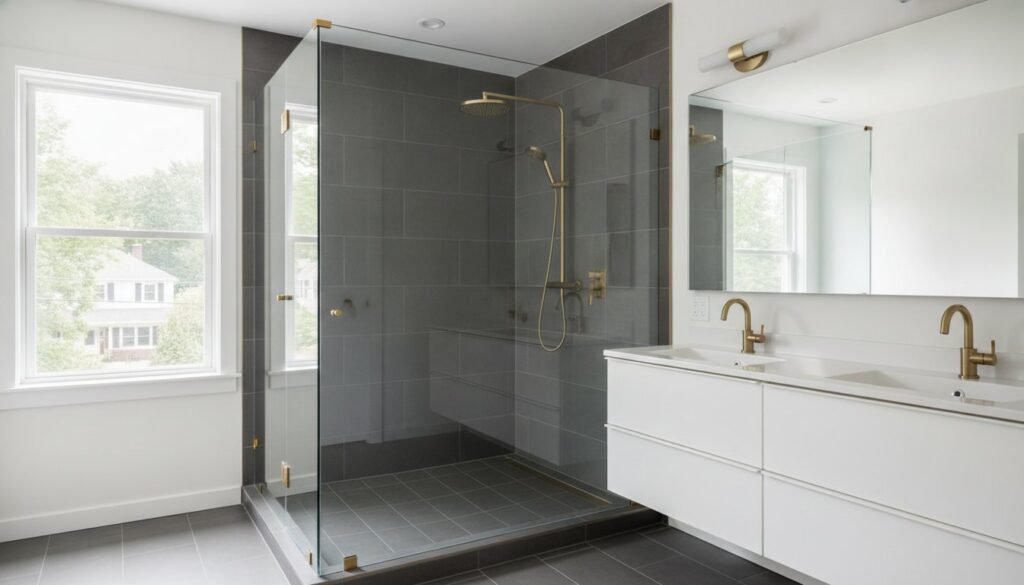
Your bathroom is the most technically complex room in your Saugus home. A single oversight in waterproofing or structural framing can turn a dream sanctuary into a costly liability. It’s completely natural to feel a sense of anxiety when you start interviewing bathroom remodeling contractors. You’re likely worried about potential project delays, hidden costs, or whether the finished work will actually meet the strict Massachusetts building codes that govern our older North Shore housing stock.
We understand that a renovation is a significant investment in your family’s comfort and your property’s value. This guide will help you master the contractor vetting process with a professional checklist designed to protect that investment and ensure a high-quality result. You’ll learn how to navigate the complexities of Home Improvement Contractor (HIC) registrations and Construction Supervisor Licenses (CSL) specific to our state. We’ll also preview the essential steps for verifying local references and ensuring your project stays on track. By the end of this article, you’ll have the tools to secure a stress-free experience and a beautiful, code-compliant bathroom that stands the test of time.
Key Takeaways
- Learn to identify critical red flags, such as unusually low bids or a lack of a local North Shore presence, that often signal hidden costs or poor craftsmanship.
- Navigate Massachusetts licensing with ease by understanding the specific roles of Construction Supervisor Licenses and Home Improvement Contractor registrations.
- Discover how to effectively vet bathroom remodeling contractors by requesting local references from projects completed on similar Massachusetts home types within the last year.
- Secure your investment by mastering the essential elements of a professional contract, including detailed scopes of work and milestone-based payment schedules.
- Understand why local expertise in Saugus municipal permits and state building codes is the foundation of a stress-free and code-compliant renovation.
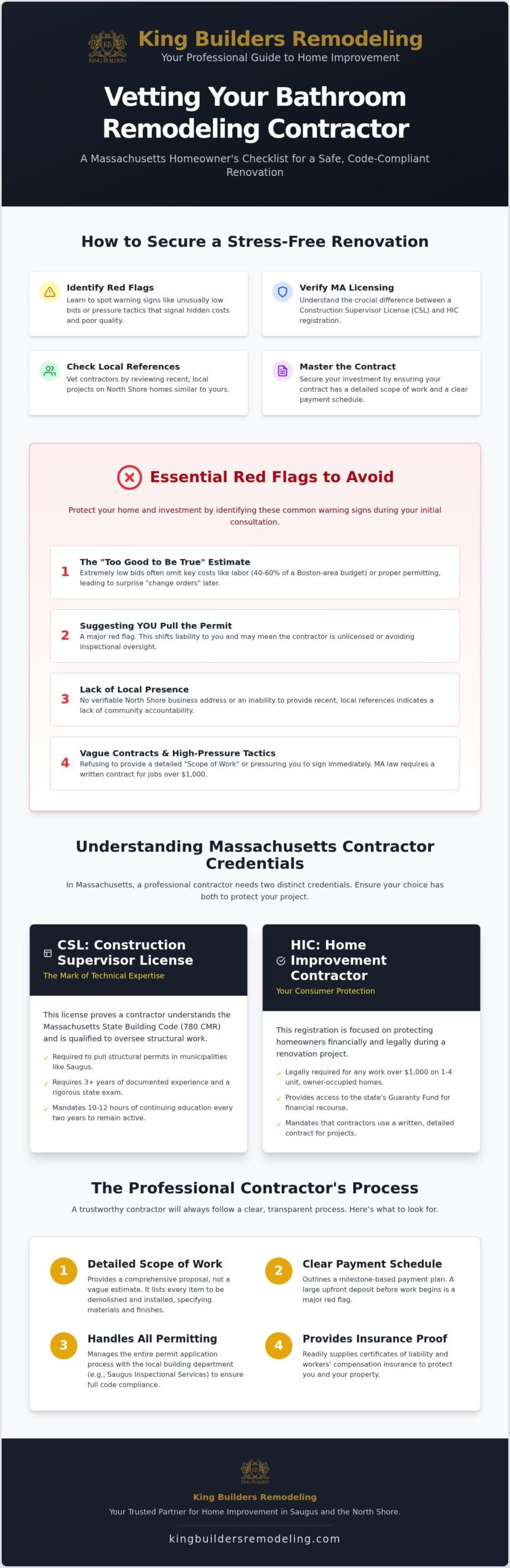
Essential Red Flags When Vetting Bathroom Remodeling Contractors
Protecting your home begins with a critical eye during the initial consultation. While many bathroom remodeling contractors present themselves as experts, subtle warning signs can help you distinguish a professional from a high-risk gamble. In Massachusetts, where the median age of owner-occupied homes is roughly 57 years, a contractor who glosses over potential structural or plumbing complexities is likely unprepared for the reality of Saugus renovations. If a candidate lacks a verifiable local business address in the North Shore or hesitates to provide local references, they may lack the community accountability necessary for a high-stakes project.
The “Too Good to Be True” Estimate
A frequent pitfall for homeowners is confusing a vague “estimate” with a fixed-price proposal. A professional proposal should be a comprehensive “Scope of Work” that lists every item to be demolished and installed. In the Greater Boston area, labor typically accounts for 40% to 60% of a total budget. If a bid comes in significantly lower than others, it often suggests the contractor hasn’t accounted for the high labor rates or the strict building codes in Massachusetts. These low bids often lead to project abandonment or a cycle of hidden change orders that eventually push the price well beyond your original budget. To truly understand the scope of responsibility required for your home, it helps to review what a general contractor does during a complex build.
Communication Gaps and Lack of Transparency
Your first interaction sets the tone for the entire build. Red flags include poor punctuality, a failure to listen to your specific vision, or pressure to sign a contract before you’ve reviewed the fine print. Massachusetts law requires a written contract for any home improvement work valued at over $1,000; any contractor suggesting otherwise is ignoring vital consumer protections. Transparency about timelines and project milestones is essential. Consistency and honesty regarding project schedules are hallmarks of a trusted general contractor Massachusetts homeowners can rely on to manage expectations effectively.
Be particularly wary of contractors who suggest you “pull the permit yourself.” This is a major red flag. In Saugus, residential alteration permits currently cost $12.00 per $1,000 of the estimated project cost. A reputable professional handles the permit process through the local building department to ensure the work is code-compliant and eligible for the state’s HIC Guaranty Fund. Other warning signs to watch for include:
- Vague answers regarding who will be on-site performing the actual labor.
- Pressure to pay a large deposit before a detailed project schedule is provided.
- Reluctance to discuss the specific Massachusetts Construction Supervisor License (CSL) requirements for structural changes.
- A lack of familiarity with the Saugus Inspectional Services Department requirements.
A principled expert won’t rush you. They’ll take the time to explain the technical steps and ensure you feel secure before a single tile is removed.
Verifying Massachusetts Licensing and Insurance Requirements
Hiring bathroom remodeling contractors in Saugus requires more than a handshake and a portfolio review. In Massachusetts, the legal framework is designed to protect your home, but it’s your responsibility to ensure your chosen professional meets these standards. Many national aggregators gloss over these details, but local expertise means knowing that a contractor needs two distinct credentials to operate legally and ethically on your North Shore property.
CSL vs. HIC: Why You Need Both
The Construction Supervisor License (CSL) is the technical qualification that proves a contractor understands the Massachusetts State Building Code, 780 CMR. To earn an unrestricted CSL, an individual must document three years of full-time experience and pass a rigorous exam. They must also complete 10 to 12 hours of continuing education every two years to maintain that license. This credential is what allows a contractor to pull structural permits in Saugus.
Conversely, the Home Improvement Contractor (HIC) registration is focused on consumer protection. Massachusetts law mandates HIC registration for any work on owner-occupied, one-to-four-unit homes where the contract exceeds $1,000. This registration gives you access to the state’s Guaranty Fund, which can compensate homeowners up to $25,000 for unpaid judgments against registered contractors. Most bathroom renovations that involve moving walls or updating old plumbing require both a CSL and an HIC registration to be fully code-compliant.
Insurance: Protecting Your Saugus or Peabody Home
Insurance isn’t just a box to tick; it’s the safety net for your largest investment. You should always request a Certificate of Insurance (COI) sent directly from the contractor’s insurance agent rather than accepting a photocopied document. A reputable general contractor typically carries at least $1 million per occurrence in general liability coverage. This protects your home from accidental damage during the build.
Workers’ Compensation is equally vital. Massachusetts law requires every employer to carry this insurance for their employees. If a member of the crew is injured on your property and the contractor lacks this coverage, you could be held liable for medical expenses and lost wages. Verifying these documents is a foundational step in avoiding home improvement scams and ensuring you’re partnering with a legitimate business.
Choosing an unlicensed “handyman” for a full bathroom remodel carries risks that extend far beyond poor tile work. Most Massachusetts homeowners’ insurance policies contain exclusion clauses for damage caused by unlicensed or unpermitted work. If a pipe bursts or an electrical fire occurs in a bathroom that wasn’t renovated by licensed bathroom remodeling contractors, your insurance provider may deny the claim entirely. Taking the time to verify these credentials ensures your project is a source of joy rather than a legal or financial burden. If you’re ready to discuss your vision with a team that prioritizes these professional standards, you can request a detailed project review from our local experts.
Evaluating Local Portfolios and North Shore References
A glossy photo on a national aggregator site rarely tells the full story of a contractor’s capability. When you’re vetting bathroom remodeling contractors, you need to see work that reflects the specific challenges of our region. A beautiful bathroom in a modern new-build is vastly different from a successful renovation in a century-old Saugus Colonial or a compact East Boston condo. You’re looking for a partner who understands how to marry modern aesthetics with the structural realities of North Shore architecture.
Experience with Local Massachusetts Architecture
Homes in communities like Lynnfield and Salem often present unique structural hurdles. Older properties frequently feature non-standard framing, settled foundations, or outdated plumbing stacks that require expert reconfiguration. A contractor with deep local roots won’t be surprised by what they find behind your plaster walls. They can anticipate these issues during the planning phase, ensuring that your vision for high-end features like curbless showers or heavy stone vanities is structurally supported. Look for portfolios that showcase transformations in homes similar in age and style to yours.
The Value of Direct References
Ask potential bathroom remodeling contractors for at least three references from projects completed within the last 12 to 18 months. Speaking directly with past clients provides insights that no website can offer. Focus your questions on the day-to-day reality of the build. Did the crew maintain a clean job site? Were they punctual and respectful of the family’s space? Most importantly, ask if the project stayed reasonably close to the initial timeline estimate. While unexpected issues can arise in any renovation, a principled expert is defined by their ability to solve problems transparently without compromising the schedule.
When you review these references or visit a past job site, pay close attention to the details of the finish work. High-quality craftsmanship is visible in the consistency of the grout lines, the precision of tile mitering around niches, and the seamless alignment of custom cabinetry. These small details are the difference between a bathroom that looks good in a photo and one that remains beautiful and functional for decades. We take pride in our history of serving this community. We encourage every homeowner to perform this level of due diligence as they plan their bathroom remodeling project.
Reviewing the Detailed Remodeling Proposal and Contract
A professional contract serves as the blueprint for your project’s success. It transforms a verbal agreement into a legally binding roadmap, ensuring both you and your bathroom remodeling contractors are aligned on every detail. In the construction industry, clarity is the best defense against frustration. A principled expert will provide a proposal that leaves no room for ambiguity, covering everything from the first day of demolition to the final inspection by the Saugus building department.
The Scope of Work: No Room for Assumptions
The “Scope of Work” is the most critical component of your contract. It should explicitly list every task, including structural framing, electrical updates, and plumbing reconfigurations. Vague descriptions like “install new fixtures” are insufficient. Instead, look for line items that specify the types of kitchen and bath cabinets, the specific tile patterns, and the exact brands of faucets being used. “Labor only” quotes are often a red flag; they frequently lead to budget blowouts because they don’t account for the fluctuating costs of high-quality materials required for a Massachusetts renovation.
Massachusetts Contract Laws for Home Improvement
In our state, the law provides specific protections for homeowners that you must verify in your contract. Under M.G.L. c. 142A, any home improvement project valued at over $1,000 must have a written contract. This document must include the contractor’s HIC registration number and a clear schedule of payments. Partnering with ethical bathroom remodeling contractors who respect these regulations ensures you’re protected by the state’s Guaranty Fund. Massachusetts law also sets specific limits on the amount a contractor can collect as a deposit and provides a “Right of Rescission,” allowing homeowners a three-day window to cancel a contract after signing.
Your contract should also detail the following administrative essentials:
- Milestone-Based Payments: Payments should be tied to completed work, such as after a rough-in inspection or upon tile completion, rather than specific dates.
- Change Order Process: A formal process for documenting and billing changes ensures that any deviations from the original plan are agreed upon in writing.
- Completion Dates: While weather and supply chains can cause shifts, a professional contract includes a firm start date and a realistic approximate completion window.
- Project Close-Out: This section should define the final walkthrough process and the requirement for all local municipal inspections to be signed off before final payment is issued.
Partnering with King Builders Remodeling for Your Project
Choosing the right team is about finding a partner who values your home as much as you do. King Builders Remodeling has spent over 10 years building a reputation for excellence in Saugus, Andover, and throughout the North Shore. We understand that a renovation is a high-stakes endeavor. As family-owned bathroom remodeling contractors, we don’t just complete a task; we strengthen a relationship within our community. Our full-service management approach means we handle every technical detail from the initial design concept through to the final municipal inspection, ensuring a smooth and predictable transformation.
Why a Family-Owned Contractor Makes a Difference
When you work with a family-run business, you’re dealing with individuals who have a personal stake in the outcome. We rely on our local reputation, which means every project is handled with a high level of accountability and neighborly respect. Our deep roots in the region have allowed us to cultivate long-term partnerships with the most skilled specialized trades and reliable local suppliers. This network ensures that your renovation benefits from a steady hand and a coordinated effort, significantly reducing the friction often found in complex construction projects. You get the peace of mind that comes from knowing exactly who is responsible for your home’s integrity.
Next Steps: Your Consultation
Preparing for your initial consultation is the first step toward your new sanctuary. We recommend gathering inspiration photos and a general list of your non-negotiable functional needs. During our professional site assessment, we’ll look closely at your existing plumbing and structural conditions to provide an honest, transparent evaluation of your project’s possibilities. This methodical approach is designed to eliminate the anxiety of hidden costs and set a clear path for success from the very beginning. We prioritize ethical practices and clear communication, ensuring you feel supported at every stage of the build.
We invite you to get a free quote today and take the first step toward your professional bathroom remodeling experience. Our team is ready to guide you through the process with the expertise and care your Saugus home deserves.
Starting Your Saugus Bathroom Transformation with Confidence
A successful renovation relies on more than just a vision; it requires a partnership with professionals who respect local standards and your budget. By identifying red flags early and verifying both Construction Supervisor Licenses and Home Improvement Contractor registrations, you secure your home against poor craftsmanship and legal liabilities. A detailed contract and a verifiable local portfolio are your best tools for ensuring that your project remains a stress-free improvement to your daily life.
Finding the right bathroom remodeling contractors in Saugus doesn’t have to be overwhelming when you prioritize transparency and local accountability. King Builders Remodeling brings over 10 years of family-owned experience to every project. We’re fully licensed and insured, serving homeowners across Saugus, Andover, Peabody, and the broader North Shore with a commitment to ethical, high-standard work.
We look forward to helping you create a space that reflects your style and stands the test of time.
Frequently Asked Questions
Do I need a permit for a bathroom remodel in Massachusetts?
Permits are necessary for most bathroom renovations in Massachusetts, especially those involving structural, electrical, or plumbing modifications. While cosmetic changes like painting or replacing a faucet in the same spot might not require one, moving a shower or adding a new circuit definitely does. In Saugus, the building department enforces these rules to ensure your home remains safe and code-compliant. Always verify specific requirements with your local building department before starting any work.
How do I verify if a contractor is licensed in Saugus or Peabody?
You can verify a contractor’s credentials through the Massachusetts Office of Consumer Affairs and Business Regulation (OCABR) website for HIC registrations. For a Construction Supervisor License, you should check the state’s professional licensing database. Additionally, contacting the Saugus Inspectional Services Department is a smart way to confirm that bathroom remodeling contractors are in good standing locally. Taking these few minutes to check protects your investment and ensures you are hiring a legitimate professional.
What is the difference between a CSL and an HIC license?
A Construction Supervisor License (CSL) proves a professional’s technical knowledge of the Massachusetts State Building Code and is required for structural work. The Home Improvement Contractor (HIC) registration is a separate requirement focused on consumer protection. It ensures you have access to the state’s Guaranty Fund if a dispute arises. Most comprehensive bathroom projects in our area require both credentials to ensure the work is technically sound and the homeowner is legally protected.
Should I buy the materials myself or have the contractor provide them?
While you might consider buying fixtures yourself, it’s generally more efficient to have your contractor provide the materials. Professionals have established relationships with local suppliers and can ensure that every component is compatible with your plumbing and electrical systems. When a contractor handles the procurement, they also take responsibility for delivery logistics and any potential damage during transit. This approach prevents project delays and ensures that all materials meet high-quality professional standards.
What should I do if a contractor asks for a 50% deposit upfront?
You should decline a request for a 50% deposit, as Massachusetts law generally limits the initial down payment to one-third of the total contract price. The only exception is when custom-made materials must be ordered in advance. A request for half the money upfront is often a red flag regarding a contractor’s financial stability. Principled bathroom remodeling contractors will provide a payment schedule tied to specific, verifiable project milestones instead of asking for excessive funds early.
How long is a typical bathroom remodel project in the North Shore area?
A typical full gut renovation in the North Shore area generally takes between three and five weeks to complete. This timeline accounts for demolition, rough-in inspections, tiling, and final fixture installation. Older homes in Saugus or Peabody can sometimes present surprises behind the walls that might extend this window slightly. A well-organized contractor will provide a realistic schedule during the proposal phase and keep you informed about any adjustments as the build progresses.
Can a general contractor handle the plumbing and electrical work?
A general contractor manages the entire project and oversees the timeline, but they must use licensed specialists for specific tasks. Massachusetts law requires that only licensed plumbers and electricians perform their respective work to ensure safety and code compliance. Your general contractor acts as the steady hand coordinating these trades, ensuring that all permits are pulled and that every phase of the project passes the necessary municipal inspections without causing unnecessary delays for your family.
What happens if my bathroom remodel uncovers structural issues or mold?
If unexpected issues like mold or structural rot are discovered, your contractor should immediately halt work in that area and notify you. In older Massachusetts homes, these discoveries are common once the walls are opened. A professional will document the problem, explain the necessary repairs, and provide a formal change order with the associated costs. This transparent process ensures that the underlying integrity of your home is restored before any new finish work begins.