
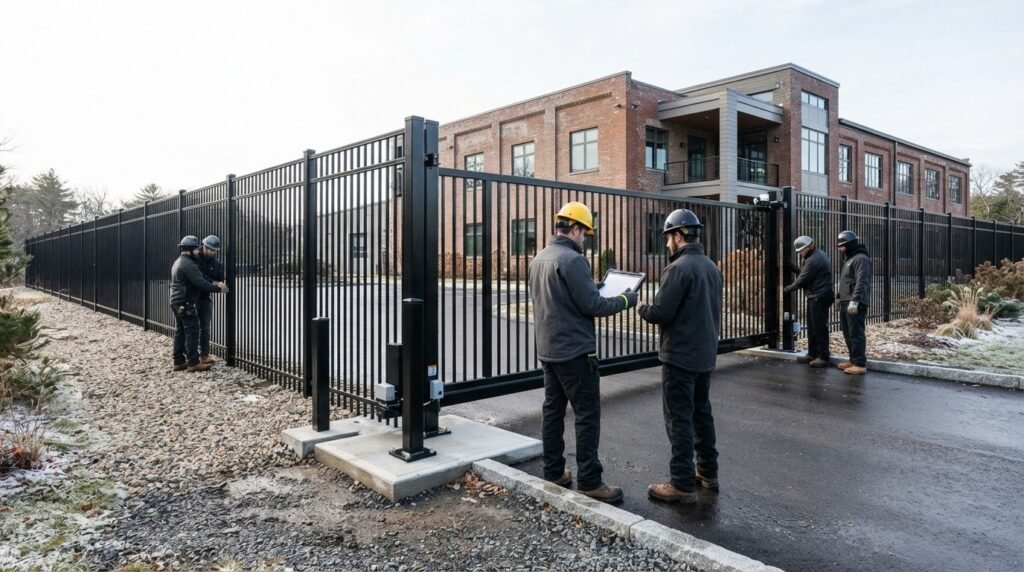
What good is an industrial perimeter if the first harsh New England freeze throws your automated gates completely out of alignment? Investing in a commercial fencing installation Massachusetts business owners can depend on demands far more than ordering panels and digging holes. Between resolving town-specific setback bylaws across the North Shore and anchoring posts deep enough to resist frost heave, commercial managers face genuine structural challenges. You shouldn’t have to compromise between robust perimeter security, seamless customer access, and sharp curb appeal.
We understand the pressure of protecting valuable assets while keeping your project on schedule and in full regulatory compliance. In this comprehensive guide, you’ll discover how to choose, plan, and install durable commercial fencing that secures your Massachusetts property and meets local codes. We’ll examine weather-hardened materials built for coastal conditions, walk through state footing depths and Dig Safe requirements, and outline the municipal permitting process. Here is your clear roadmap to securing your commercial facility for the long haul.
Key Takeaways
- Match your facility’s security and aesthetic demands with heavy-duty materials engineered to withstand coastal New England storms and road salt exposure.
- Ensure your commercial fencing installation Massachusetts project remains fully code-compliant by planning for local municipal setback bylaws and mandatory frost-line footing depths.
- Protect your timeline and commercial investment by managing critical pre-construction milestones, including boundary verification and Dig Safe utility coordination.
- Discover the operational advantages of partnering with an experienced general contractor who handles structural site preparation, local building department approvals, and turnkey project management.
Why Commercial Properties in Massachusetts Require Specialized Perimeter Solutions
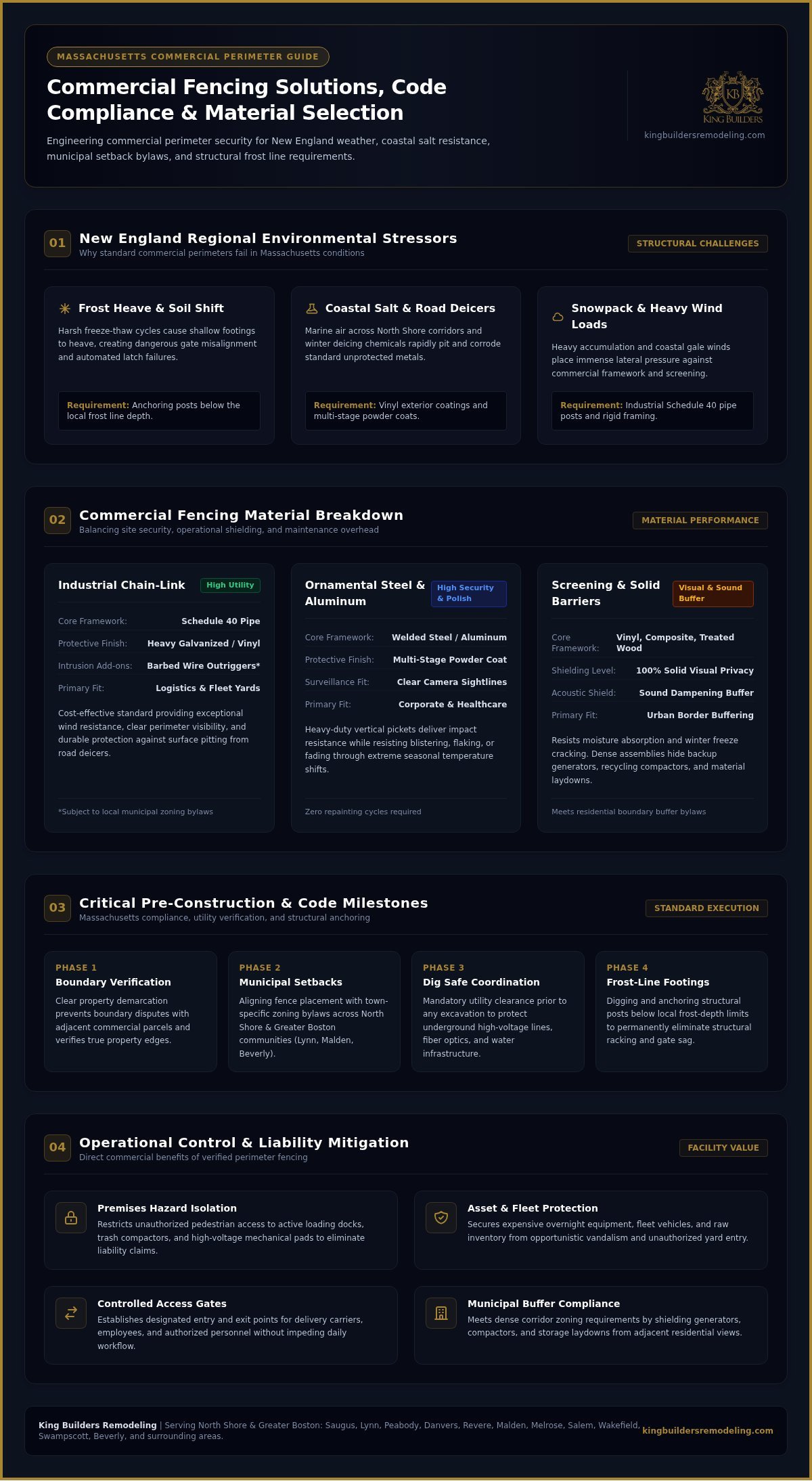
Operating a commercial facility in New England involves specific regional challenges. Heavy snowpack, harsh coastal salt air, and aggressive winter deicing chemicals quickly degrade subpar barriers. Because of these distinct environmental stressors, a proper commercial fencing installation Massachusetts business leaders invest in must balance structural resilience with everyday operational control. Clear boundary demarcation prevents costly disputes with neighboring parcels while ensuring your perimeter satisfies local zoning frameworks.
Site Security, Asset Protection, and Liability Reduction
Industrial yards and commercial lots house valuable equipment, fleet vehicles, and raw inventory overnight. A sturdy perimeter eliminates easy pedestrian access points, safeguarding expensive machinery from vandalism and theft. At the same time, verified containment plays a direct role in premises liability mitigation:
- Restricts unauthorized access to active loading docks, trash compactors, and high-voltage mechanical pads.
- Establishes controlled entry gates for delivery carriers, employees, and authorized personnel.
- Prevents structural racking and sagging caused by unstable New England soils, provided structural posts anchor below the local frost line depth.
Fences that shift during freeze-thaw cycles create dangerous latch failures. Securing your perimeter with commercial-grade framework protects your physical assets and shields your company from avoidable injury claims.
Visual Privacy and Commercial Operational Shielding
In dense North Shore and Greater Boston corridors, commercial facilities frequently share borders with residential neighborhoods. Cities like Lynn, Malden, and Beverly often enforce strict buffering standards to shield industrial activity from public view. Strategic fencing solves this operational friction cleanly. Dense wood panels, industrial composite boards, or privacy-screened chain-link effectively hide backup generators, recycling compactors, and material laydown areas. Beyond satisfying local site plan requirements, an attractive, well-aligned perimeter presents an orderly facade to visiting clients and corporate partners, demonstrating that your business takes pride in its community footprint.
Evaluating Commercial Fencing Materials for New England Weather and Security Needs
Selecting the right barrier requires balancing site-specific security with the physical realities of Massachusetts winters. Ground moisture, freezing conditions, and coastal air rapidly break down residential-grade products. A successful commercial fencing installation Massachusetts property managers oversee starts with evaluating perimeter visibility, physical intrusion protection, and long-term maintenance overhead.
Heavy-Duty Galvanized and Vinyl-Coated Chain-Link
For large logistics yards, manufacturing hubs, and fleet storage, commercial chain-link remains a proven, cost-effective standard. Industrial schedule 40 pipe posts deliver the structural strength required to resist heavy winds and snow accumulation. Coating the core wire in tough exterior vinyl prevents surface pitting from corrosive road deicers and marine salt air. Depending on local municipal bylaws, security outriggers with barbed wire can be integrated along industrial boundary runs to prevent unauthorized perimeter crossing.
High-Strength Ornamental Steel and Commercial Aluminum
Corporate headquarters, healthcare campuses, and retail plazas often require robust deterrence that looks polished and welcoming. Ornamental aluminum and welded steel fulfill this role effortlessly. Heavy-duty vertical pickets offer substantial impact resistance while maintaining clear camera sightlines across parking lots. Multi-stage architectural powder coatings protect against fading, flaking, and blistering during New England’s extreme seasonal temperature swings, eliminating the need for ongoing repainting cycles.
Commercial Vinyl, Composite, and Solid Wood Screening
Properties requiring complete visual shielding or perimeter sound dampening benefit from solid barrier systems. Commercial-grade vinyl profiles resist moisture absorption and cracking throughout deep winter freezes. Meanwhile, thick pressure-treated wood or heavy composite assemblies create clean acoustic buffers between active commercial loading areas and neighboring parcels. Installing boundary fencing also requires adherence to Massachusetts General Laws Chapter 49, which governs property lines and partition fences. You can explore our construction standards on the King Builders Remodeling about page. If your team is evaluating specifications for an upcoming build, request a project estimate to discuss tailored material solutions for your property.
Navigating Massachusetts Building Codes, Frost Lines, and Municipal Permitting
Every commercial fencing installation Massachusetts contractors execute must satisfy two distinct authorities: state structural mandates and local zoning ordinances. While the Massachusetts State Building Code (780 CMR) provides baseline structural safety standards, individual towns maintain independent zoning bylaws. Navigating these overlapping layers early prevents costly mid-build stop-work orders and redesigns.
Frost Line Engineering and Ground Stability
New England winters produce relentless ground movement. Under 780 CMR, commercial structural footings must extend to a minimum depth of 48 inches below grade to anchor past the active frost line. Auger holes drilled short of this standard risk frost heave, which pushes concrete upward and throws gate latches out of square within two seasons. Professional builders bell out the bottom of concrete footings and tamp down crushed stone aggregate beneath each post, creating a reliable escape route for trapped groundwater.
Municipal Permitting, Zoning Bylaws, and Setback Rules
Although 780 CMR Section 105.2 exempts fences up to 7 feet from requiring a statewide structural building permit, local municipal bylaws hold final authority. Cities across Greater Boston frequently cap front-setback commercial fences at 4 feet, while side and rear boundaries often allow 6 to 8 feet depending on the zone:
- Sight Triangles: Tight restrictions govern driveway aprons and corner curb cuts to keep driver sightlines clear.
- Property Line Buffers: Commercial parcels abutting residential zones face specific screening and setback mandates.
- Wind-Load Analysis: Solid composite panels and chain-link privacy windscreens often require documented wind-load calculations before permit issuance.
Always verify your site plan with your local municipal building department before purchasing materials, as requirements vary significantly between neighboring communities.
Dig Safe Protocols and Underground Utility Protection
Excavating dozens of commercial post holes demands strict subterranean coordination. Massachusetts General Laws Chapter 82 requires contractors to notify Dig Safe at least 72 business hours prior to breaking ground. This mandatory window gives public utility providers time to mark underground electrical feeds, gas mains, water mains, and fiber lines with color-coded paint. Our team coordinates this workflow directly across our trusted Massachusetts service areas, ensuring every structural post goes into the ground safely without threatening crucial property utilities.
The Commercial Fencing Installation Process: Step-by-Step Execution
Executing an exterior commercial build demands methodical coordination. Unlike basic residential jobs, perimeter construction on an active industrial lot requires minimal disruption to fleet access, customer parking, and freight traffic. A turnkey commercial fencing installation Massachusetts facilities trust depends on phased execution, structural precision, and close oversight at every milestone.
Phase 1: Site Evaluation, Surveying, and Ground Preparation
Every commercial build begins with precise layout planning. Our crew reviews certified plot plans and physical boundary monuments to confirm that every linear foot stays entirely within legal limits, preventing friction with abutting parcels. During this walk, we evaluate elevation changes, natural drainage swales, and subsoil challenges like rocky glacial till. Construction logistics are established immediately with property operations, staging machinery and stockpiles away from daily delivery traffic and tenant pathways.
Phase 2: Post Hole Augering and Concrete Foundation Pouring
Once utility paths receive official markouts, heavy equipment moves in to dig foundation holes. We use industrial augers to drill past coastal cobble and heavy clay to reach the required 48-inch depth below the frost line. Each heavy-gauge steel post or structural wood support is plumbed with precision levels and braced before pouring. We fill post holes with commercial-strength concrete mix, sloping the top collars away from the steel to shed surface water. The concrete is given full curing time before crews hang gates or apply mechanical tension.
Phase 3: Panel Construction and Commercial Gate Integration
With foundations fully cured, assembly begins along the perimeter:
- Framework runs are secured using heavy-duty structural bands, top rails, and bracing bars.
- Chain-link mesh is stretched tight with industrial pullers, or rigid ornamental panels are anchored into place.
- Cantilever slide gates, overhead track systems, or wide double swing gates are hung with commercial-grade ball-bearing hinges.
- Latch assemblies and automation hardware undergo thorough alignment testing to guarantee smooth daily operation.
Managing complete perimeter developments often involves grading and structural framing adjustments. Learn how we deliver turnkey commercial solutions by collaborating with a trusted general contractor in Saugus Massachusetts.
Why Partner with King Builders Remodeling for Your Massachusetts Commercial Fencing
Commercial perimeter fencing rarely exists in isolation. Upgrading property security often requires accompanying site adjustments, including exterior framing repairs, bollard placement, or facility repainting. King Builders Remodeling brings over a decade of hands-on building experience to commercial property managers across Saugus, Lynn, Peabody, Danvers, and surrounding Greater Boston communities. As an established, family-owned general contractor rather than a simple fence supplier, we look at your site holistically. We also coordinate complementary facility improvements, such as commercial painting contractor services in Saugus MA, ensuring your entire commercial exterior remains durable and cohesive.
Comprehensive General Contracting and Structural Expertise
Subcontractors who only handle fencing often walk away when they encounter site irregularities, like unstable retaining walls or uneven grades. Our background in commercial construction and exterior framing eliminates these operational bottlenecks. We manage your entire scope under one contract, whether your facility requires heavy-duty automated gate footings, trash enclosure framing, or expanded structural barriers. We apply the same structural precision to commercial barriers that we bring to high-end exterior living projects, as detailed in our guide on custom deck installation in Saugus MA. Partnering with a full-service builder means single-source accountability from the initial layout to the final latch inspection.
Reliable North Shore Project Management and Permitting Guidance
Commercial construction cannot afford avoidable downtime or uncoordinated trade schedules. Executing a commercial fencing installation Massachusetts business leaders can depend on requires proactive municipal navigation. Because our team works routinely with municipal building departments across Essex and Middlesex counties, we understand local setback requirements, sightline rules, and inspector sign-off procedures. We communicate directly and honestly, establishing realistic milestones that keep delivery trucks moving and parking lots accessible throughout the build. Ready to secure your business perimeter with lasting craftsmanship? Request your free commercial estimate today.
Build a Lasting Perimeter for Your Massachusetts Business
A dependable boundary safeguards your inventory, controls daily facility traffic, and reinforces professional credibility. Achieving a high-performing commercial fencing installation Massachusetts businesses can rely on requires balancing durable materials with deep frost-line engineering and town-specific zoning rules. Addressing these structural factors proactively ensures your security barriers withstand severe coastal nor’easters without shifting out of square.
For over a decade, King Builders Remodeling has partnered with business owners across Saugus, the North Shore, and Greater Boston. As an established, family-owned general contractor, we manage your exterior site improvements holistically. Whether your property needs structural framing adjustments, heavy-duty perimeter fencing, or commercial painting, we deliver turnkey execution backed by honest communication and seasoned local craftsmanship.
Take the next step toward fortifying your commercial property with a dedicated local builder who treats your timeline and investment with the care they deserve.
Frequently Asked Questions
Do I need a building permit for commercial fencing installation in Massachusetts?
Yes, most commercial projects require municipal building department approval or zoning verification. Under 780 CMR Section 105.2, fences 7 feet or under are exempt from statewide structural building permits, but local bylaws in towns like Lynn, Saugus, or Peabody frequently mandate zoning permits regardless of height. Installations exceeding 7 feet trigger mandatory structural plan reviews. We always recommend confirming local regulations with your municipal building department before purchasing materials.
How deep do commercial fence posts need to be installed in Massachusetts?
Commercial structural fence posts must anchor at least 48 inches below finished grade across Massachusetts. Table R301.2(1) of 780 CMR specifies this 48-inch statutory frost line depth to counteract aggressive winter frost heave. Setting footings shallower than four feet allows ground moisture to freeze, expand, and thrust posts upward, throwing gates and latches out of alignment. Proper installations also require flared concrete footings and crushed aggregate drainage at the base.
What is the most durable commercial fencing material for New England winters?
Heavy-duty galvanized or vinyl-coated chain-link and powder-coated ornamental aluminum provide the greatest durability against harsh New England winters. Coastal winds, heavy snowpack, and corrosive highway deicing salts quickly deteriorate substandard barriers. Industrial schedule 40 vinyl-coated chain-link withstands impact and resists salt spray along coastal areas like Beverly and Revere. Commercial-grade aluminum doesn’t rust, making both materials dependable options for any commercial fencing installation Massachusetts properties require.
How high can a commercial security fence be built on a Massachusetts business property?
Allowable fence heights depend directly on your property’s specific commercial zoning designation and local municipal bylaws. Most municipalities restrict front setback fencing to 4 feet to preserve clear vehicular sightlines, while side and rear lot lines typically permit heights between 6 and 8 feet. Installing perimeter barriers beyond standard municipal allowances requires a formal variance through your local Zoning Board of Appeals. Check with your town’s building commissioner to verify parcel-specific limits.
Can you install commercial cantilever slide gates and automated access controls?
Yes, we coordinate complete commercial gate assemblies, including counterbalanced cantilever slide systems and heavy-duty double swing gates. Reliable gate operation requires substantial footings drilled past frost depth so tracks remain perfectly level throughout winter freezes. While we manage the physical gate structures, framing, and alignment, motorized gate operators and access keypads also require licensed Massachusetts electrical sign-offs under local code. We coordinate these steps to ensure smooth entry access.
How long does a typical commercial fencing installation take to complete?
Most commercial fencing installations take between several days and a few weeks, depending on overall linear footage and site terrain. Ground preparation, boundary verification, and augering deep post holes through rocky Massachusetts subsoils take up the initial phase. Commercial concrete footings also require dedicated curing time before crews can tension framework or hang heavy sliding gates. We phase construction carefully around your facility’s active shipping hours to minimize daily operational disruption.
What steps are required to comply with Massachusetts Dig Safe regulations?
Massachusetts law mandates contacting Dig Safe at least 72 business hours before excavating any commercial post holes. Under M.G.L. Chapter 82, contractors must pre-mark proposed digging areas in white paint before utility locators arrive. Utility providers then locate and spray-paint subterranean gas, power, water, and telecom lines. Valid for 30 calendar days, this clearance protects underground infrastructure, making it an essential pre-construction milestone for every commercial fencing installation Massachusetts contractors oversee.